
Knowledge base
Tesla vs BYD in Australia: which EV suits your budget, driving, and finance plans?
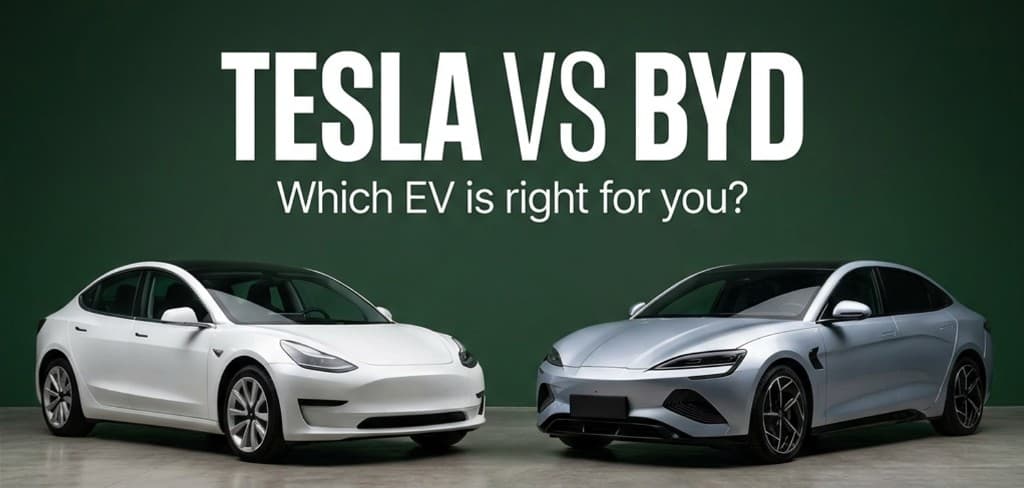
BYD generally wins on price and value, with the current Atto 3 Evo offering up to 510 km WLTP range on its longest-range variant, while Tesla's Model Y starts from $58,900 before on-road costs and leads on charging ecosystem and software experience.
For some people, BYD wins on value straight away. For others, Tesla still feels worth the extra spend because of the charging ecosystem, software experience, and brand confidence.
It is not really about which brand is better. It comes down to which one suits how you drive, what you value, and what you are comfortable spending, both upfront and over time.
This guide is built to help you compare the practical differences and then understand what the next step could look like if finance is part of the plan.
Australian broker team • Personal and business buyers • No-obligation guidance • Real people, not a generic queue
Quick answer
Choose BYD if your main priority is getting strong EV value for the money and keeping the purchase price tighter.
Choose Tesla if you place more value on the charging ecosystem, software-led ownership experience, and the confidence that comes from buying a brand that has already become a default EV reference point for many Australians.
If you are still stuck between the two, watching another review video probably will not settle it. Compare the vehicles on ownership cost, repayments, and how long you actually plan to keep the car.
1. Price is usually where the decision starts
This is where BYD usually gets your attention first.
Tesla still commands a premium in Australia. Tesla’s Australian Model Y design page currently shows pricing starting from $58,900 before on-road costs, with the final drive-away price varying by state and personal circumstances.
BYD’s appeal is that it has pushed hard into the value end of the EV market. That is why buyers comparing these two brands are often really asking one of two questions:
- is Tesla worth the extra money?
- or is BYD already enough car for what I need?
That is where finance and budgeting become part of the decision. A higher upfront price may or may not feel significant once spread across a sensible term. On the other hand, the cheaper car is not automatically the better buy if it misses what matters most to you. Plug both prices into our loan repayment calculator to see the weekly or monthly difference before you talk to a broker.
Trying to work out whether the Tesla premium is actually worth it?
We can help you compare rough repayments on the models you are seriously considering.
Australian brokers. Straight answers.
2. Charging confidence matters more than most buyers expect
For many Australians, the biggest day-to-day ownership difference is not the badge. It is charging confidence.
Tesla still benefits from the strongest brand association with fast charging, and that matters for buyers who want a simpler road-trip experience. Tesla also says that select Supercharger locations in Australia are open to non-Tesla vehicles, which is important because the old assumption that Tesla charging is only for Tesla drivers is no longer completely true.
BYD drivers can use the broader public charging network and, for many households, daily charging will mainly happen at home anyway. If your driving is mostly commuting, school runs, local business use, and suburban trips, both brands can work very well.
The better question is not “which one can charge?” but:
- how often do you do long-distance driving?
- how important is charging convenience on trips?
- will most charging happen at home?
If most of your charging will happen overnight at home, both Tesla and BYD can make a lot of sense.
3. Range is important, but daily use matters more
Range figures matter, but they are only one part of the story.
Tesla has long held a reputation for competitive range and strong efficiency. BYD has narrowed that gap significantly as its Australian lineup has expanded - the Atto 3 Evo, released September 2026, now claims up to 510 km WLTP on its longest-range Premium variant, and 420 km on the entry Dynamic, which is already more than enough for a large share of everyday driving patterns.
For most buyers, a better question than “which car has the highest number on paper?” is:
- will this comfortably handle my week?
- how often do I really need public charging?
- am I paying extra for range I may rarely use?
The answer often depends on whether the vehicle is for city commuting, family use, business travel, or frequent highway work.
4. Interior feel is often the deal-maker or deal-breaker
Tesla is known for its minimalist cabin design and strong reliance on the central screen. Some buyers love the clean, tech-forward feel. Others find it too stripped back.
BYD tends to feel more familiar to buyers stepping out of petrol or diesel vehicles, with a cabin layout that can feel easier to adapt to straight away.
This part is highly personal. On paper, two vehicles can look close. In person, one often feels obviously more natural.
That is why a Tesla vs BYD decision should never be made on specs alone. Test driving both is worth it.
5. Resale confidence still matters
Tesla has had longer to build a resale track record in Australia, and that gives many buyers a bit more confidence when thinking about future value.
BYD’s resale story is newer. That does not automatically make it weak. It simply means there is less Australian history to lean on.
If resale is important to you, do not just ask which brand might hold value better. Also ask whether the extra money going into the purchase today is actually justified for your situation.
This is where finance structure matters. Term length and any balloon or residual decisions should reflect how long you plan to keep the vehicle and how comfortable you are with depreciation risk.
Want to compare the finance side before you commit?
If you already know the Tesla and BYD models you are weighing up, we can help you understand what the rough repayment difference may look like and which finance paths may suit your situation.
Whether you are buying personally or through a business, the structure can change how the decision feels in practice.
So, who should choose Tesla and who should choose BYD?
Choose BYD if you want strong value for money, a lower step into EV ownership, and a vehicle that covers your real-world needs without stretching the budget unnecessarily.
Choose Tesla if you are comfortable paying more for the broader ownership ecosystem, the Tesla software experience, and the confidence that comes from a brand with deep EV mindshare.
Choose neither yet if you still have not worked out your budget, use case, or shortlist. In that case, your next step is not finance. It is refining the shortlist first.
That said, once the shortlist is real, finance becomes part of the decision. The right structure can make a good EV feel achievable. The wrong structure can make even the right vehicle feel uncomfortable.
EVFinancer helps Australians explore EV finance options through a real broker network. It is a simple, no-pressure starting point, not a blind online application.